What changes
The document before departure
It must exist before the lorry leaves, generated from data and with the creation date embedded. Paper remains, but only as a carrier for the QR code.
DeCA module for Caotic · live since 8 September 2026
In Spain, the road transport control document becomes electronic and downloadable through a QR code. Caotic generates it before departure, publishes it and prints the QR code for you, from the same dispatch screen as always. You do not change systems or install anything.
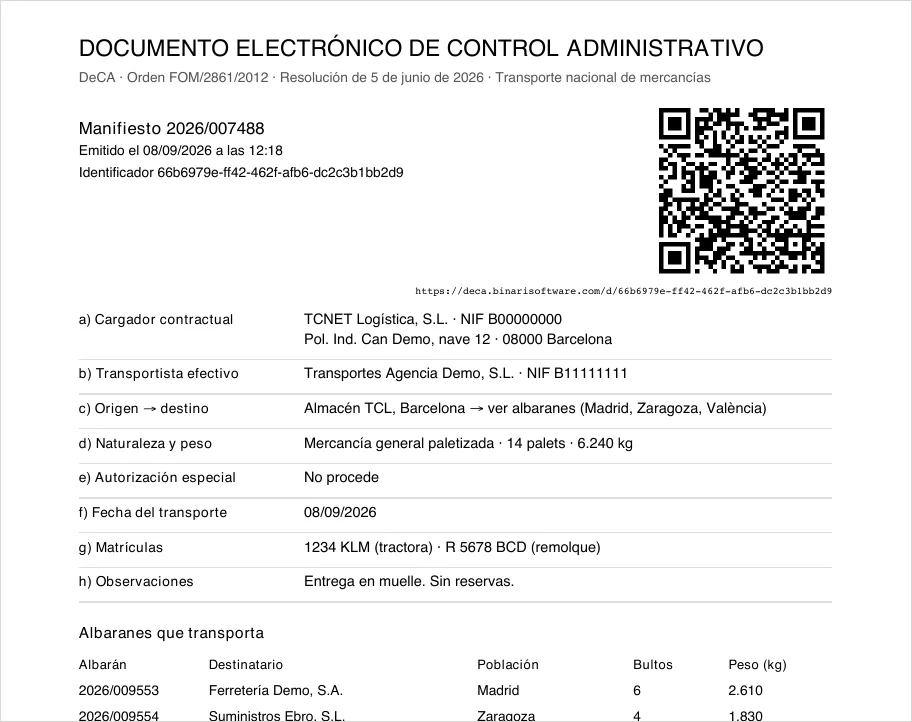
Every road transport of goods in Spain must carry a control document. Until now it was a piece of paper. From 5 October 2026 it has to be a PDF with a QR code that an inspector can download on the road, without credentials. It is mandatory, it has a date and it affects every departure from your warehouse.
What changes
It must exist before the lorry leaves, generated from data and with the creation date embedded. Paper remains, but only as a carrier for the QR code.
Who is liable
The contractual shipper and the actual carrier. If your warehouse contracts the transport, the obligation is yours. It cannot be left to “the lorry will sort it out”.
What Caotic does
It composes the document with the data it already has in the manifest, publishes it on Binari’s DeCA service and prints the QR code for you. One more document in the usual dispatch.
Three steps. Caotic does the first two on its own; the inspector does the third with their phone.
01 · Before departure
With the manifest data it composes the PDF of the control document, with the creation date embedded and the QR code inside.
02 · In seconds
The document is stored on Binari’s DeCA service. Only once it is confirmed does Caotic print: a lorry never leaves with a QR code that does not work.
03 · On the road
The driver shows the paper or the phone. The inspector scans the QR code and the PDF opens on their phone, with no user or password.
A lorry breaks down and another one carries on with the load. The regulation requires the change of vehicle to be recorded in the control document (art. 6 g of Order FOM/2861/2012), and a handwritten note on the printed copy is not valid (Resolution of 5 June 2026, section seven). With Binari’s DeCA service, the carrier records it on the spot: the driver does it from their phone, without anyone at the office having to step in.
01 · From the phone
The document downloaded through the QR code carries a “Modificar este documento” (modify this document) link. It opens a very short form on the phone, already filled in with the document’s data: the date of the service, the actual carrier, the vehicle and trailer number plates and the driver with their ID number (DNI or NIE). The driver corrects whatever changes and gives the reason and their own name. One button.
02 · In the same PDF
A stamp at the top of the first page states that the document has been modified and that the replaced data is no longer valid. A final “Modificaciones” (modifications) page is added with the new value, the one it replaces, the reason, who made the change and when.
03 · On the road
Neither the QR code nor the address changes: an inspector who scans it downloads the updated document. The creation date of the PDF, which proves it was issued before departure, is not touched.
04 · At the office
An email to the addresses you have configured: what changed, who, when and why, with the modified PDF attached and a link to the document’s history. With that notice, you update the data in your own system.
The control document has existed since 2013. What is new is the form: Spanish Law 9/2025 requires it to be electronic from 5 October 2026, and the Resolution of 5 June 2026 sets how the file, the QR code and the download must work. It applies to domestic transport of goods; the international CMR comes in 2027.
What the regulation requires and how it is covered, checked against the text published in the Spanish Official Gazette (BOE).
Each DeCA’s address is random. Without the QR code of that specific document there is no way to reach it, and the download link lives for one minute only.
Each warehouse publishes with its own key and its documents live in a separate space, with your name in no address.
Documents are stored, encrypted, in Amazon Web Services data centres in Spain. They do not leave the European Union.
A DeCA carries names and addresses. Binari keeps them on your behalf under the data processing agreement required by the GDPR, included in the implementation.
Not much, and we do it together. Four decisions and one change of habit.
What you do not have to do
The date is fixed: 5 October 2026. From that day on, a lorry that leaves without a DeCA leaves without a control document.
Week 1
Kick-off meeting: contractual shipper, carriers, dispatch process. Service sign-up and test key.
Week 2
First documents in the test space: you scan them and see them on your phone.
Week 3
With the dispatch team. Data processing agreement.
Go-live
Every departure carries its DeCA. Binari monitors the service.
We issue a document in front of you, print it, and you scan the QR code with your own phone. You will see the PDF download without being asked for anything. It is exactly what an inspector sees on the road.
Regulatory references: Spanish Law 9/2025 · Order FOM/2861/2012 (BOE-A-2013-154) · Resolution of 5 June 2026 of the Directorate-General for Road and Rail Transport (BOE-A-2026-12784). Commercial explanation; it does not replace legal advice.
If you already use Caotic, activation is a configuration task. If not, we show you the module with your own shipments.
+34 93 866 37 30
Travessia, 14, Sant Feliu de Codines
Monday to Friday, office hours